SRE
Digital Innovation and Transformation in Times of Change: A Success Story of ARO Implementation
28 April 2022 | Por Possumus
Success story: How ARO implementation helped expand operational capacity and respond to rising demand during the pandemic.
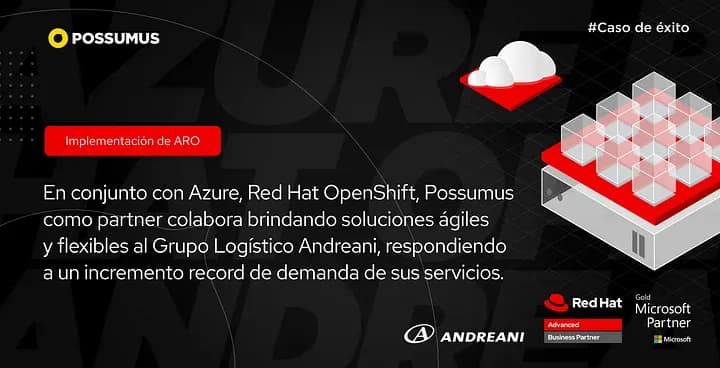
The ARO (Azure Red Hat OpenShift) system is a service jointly managed by Microsoft and Red Hat that lets companies scale their operational capacity without investing in hardware. Andreani, a leading Argentine logistics company, deployed it during the pandemic to absorb a 35% surge in demand in record time, optimizing deliveries and cutting CAPEX costs.
The pandemic transformed consumer habits, but it also changed what it means to operate at scale. For logistics companies, e-commerce exploded overnight, and those without flexible technology infrastructure found themselves in trouble. Andreani, the leading logistics company in Argentina, felt that pressure firsthand. But it found in the ARO system the lever it needed to hold its ground.
Andreani's success story is less about technology and more about an organization's ability to make strategic decisions under pressure, modernize its IT infrastructure without losing operational continuity, and come out the other side stronger than before. If you lead technology or infrastructure teams at a mid-sized or large company, what Andreani achieved has direct implications for your own digital roadmap.
Red Hat OpenShift Services on Microsoft Azure (ARO)
ARO is a managed service with two subdivisions: the complete platform service, and the tools to develop and/or run applications on it. The installation and management of OpenShift as a platform is handled by Microsoft and Red Hat through joint automation. This lets you focus solely on running or developing your applications, without worrying about platform maintenance or potential hardware issues.
What sets it apart from other solutions is its shared responsibility model. Installation, ongoing maintenance, critical updates, and cluster management stay in the hands of the joint Site Reliability Engineering (SRE) team from both companies. The customer (whether a financial corporation, a logistics company, or a SaaS provider) concentrates exclusively on their applications and the business value they generate.
From a technical standpoint, ARO runs on Red Hat Enterprise Linux CoreOS (RHCOS) with CRI-O as its container engine. Each cluster includes a fully managed control plane and worker nodes deployed across Azure availability zones, which ensures high resilience. Block storage uses Azure-managed premium SSD disks with LRS, and the billing model works on actual consumption, eliminating the fixed costs of traditional infrastructure.
For companies with operations in Latin America, one relevant detail is ARO's recent expansion into regions like Central Chile and Central Mexico, which makes it easier to meet data residency requirements at the regional level.
Boost business agility by modernizing IT
Development teams need resources available immediately. Operations teams demand stability and security. Those two priorities rarely coexist easily in traditional infrastructures.
The ARO system resolves that tension by combining Kubernetes, hybrid cloud, multicloud, and container technology in a single unified platform. Workloads run uniformly in both on-premises and cloud environments, which allows organizations to migrate gradually without disrupting their current operations.
Red Hat's open source technologies enable adaptation to hybrid and multicloud architectures. This matters for companies operating with legacy systems (as frequently happens in banking, oil & gas, and logistics).
Among its most recent capabilities, ARO adds support for OpenShift Virtualization, which lets you run virtual machines and containers on the same platform. This considerably simplifies the transition for organizations that have not yet fully migrated to containerized environments.
Our client Andreani: scaling up 35% in weeks, not years
Grupo Logístico Andreani has been the leading logistics company in Argentina for 75 years, with operations in Brazil and Uruguay. Its focus on technology as a competitive differentiator positions it in high-value-added sectors: pharmaceutical laboratories, financial institutions, e-commerce, telecommunications, and cosmetics, among others.
How do you handle a surge in demand in record time?
Driven by the transactions caused by the nationwide explosion of e-commerce, the pandemic pushed Andreani to an operational level it had only projected reaching by 2023.
"Between April and May we saw a 35% increase in volume over our best number,""Between April and May we saw a 35% increase in volume over our best number," explains Sebastián Sarasate, Infrastructure Manager at Andreani Grupo Logístico.
The number projected for 2023 arrived in 2020. Two years ahead of schedule. The IT team faced simultaneous pressure on two fronts: the human and the technical. Adding staff, scaling systems, maintaining operational continuity, and doing it all with no time for extensive planning.
This event was as rewarding as it was challenging for Andreani: the increase in demand would create a huge overload for the company, both for the IT team and its technical counterpart.
What solutions did the ARO system enable in practice
Deploying ARO delivered a general infrastructure shift while also allowing the rollout of specific, customized solutions for the concrete challenges the pandemic imposed:
- Branch appointment management: Andreani developed tools to assign appointments and distribute attendance across predefined time slots, avoiding crowding and complying with health protocols.
- Health self-reporting: Features were implemented so customers could report their health status independently, reducing the operational burden on staff. -** Address Normalization and Routing:** Built on OpenShift, these tools allowed the new delivery personnel—hired to respond to the increase in shipments—to optimize their delivery routes from branches to homes more efficiently from day one.
- Changes in delivery methods: The platform enabled agile modifications to service flows without the need for complex infrastructure interventions.
Thanks to ARO, Andreani saves the time and CAPEX cost—both in IT and in branches—needed to expand its operational capacity and respond to the increase in demand. One example came when Andreani began to grow and take on new jobs to keep up with the rise in shipments. With the Address Normalization and Routing tools, built on OpenShift, the new delivery personnel optimized their loading and delivery service from the branch to customers' homes.
The strategic value of operating on a managed platform
For an Infrastructure Manager or IT Director, the question isn't only "does it work?" but "who takes charge when something fails?" With ARO, the answer is clear: Microsoft and Red Hat, through their joint SRE team, available continuously.
This has a direct impact on the internal team's ability to focus on what truly generates value. Instead of managing platform updates, security patches, or hardware problems, Andreani's team could concentrate on developing and deploying the solutions the business needed urgently.
From a security standpoint, ARO offers support for confidential containers that protect sensitive workloads, identity management through Managed Identities that eliminate the risk of long-term credentials, and network encryption over virtual machines with premiumIO. For regulated industries or those with critical data, these capabilities aren't optional—they're requirements.
From operational challenge to competitive advantage
Andreani's case demonstrates something IT leaders know well but can rarely prove with numbers: flexible infrastructure isn't an expense, it's a strategic capability. Absorbing a 35% surge in demand in weeks, without collapsing systems or driving up CAPEX, is the kind of result that justifies any investment in technology modernization.
The ARO system, as a platform jointly managed by Microsoft and Red Hat, gives mid-sized and large organizations a foundation to scale with agility, operate securely, and free their IT teams to focus on developing solutions that directly impact the business.
At Possumus, we are a Microsoft Partner with proven experience implementing Azure Red Hat OpenShift for companies in Argentina, Brazil, and the United States. If your organization faces challenges around scalability, migration, or infrastructure modernization, we can help you design the right solution.
Request a free consultation with our team


Products


Copyright © 2026 Possumus. All Rigths Reserved.
Join Us


